Bakuchiol
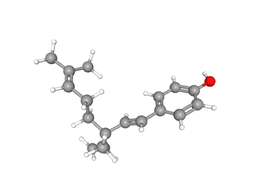
Summary: A plant-derived active compound that produces several of retinol's anti-aging effects without the irritation or photosensitivity concerns associated with retinoids.
Published on: 24/04/2026
Bakuchiol is a naturally occurring compound extracted from the seeds and leaves of Psoralea corylifolia. It shares no structural resemblance with vitamin A, and yet in clinical trials it has produced comparable results to retinol for signs of photoaging — with significantly fewer side effects [1, 2].
Mechanism of action
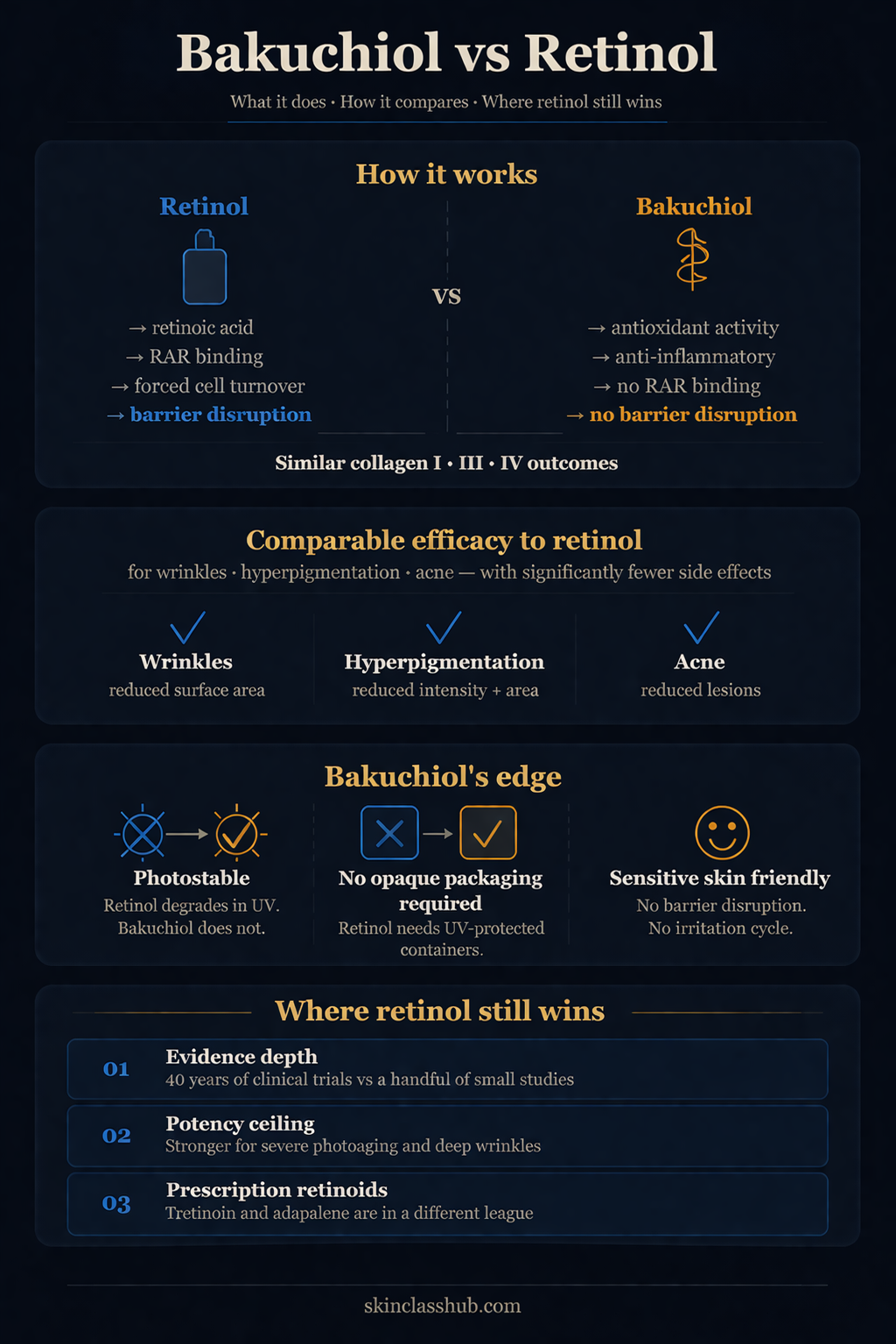
Retinol is metabolised in the skin through two enzymatic conversion steps — first to retinaldehyde, then to retinoic acid — which binds directly to nuclear retinoic acid receptors (RARs) and switches on genes responsible for accelerating cell turnover and collagen synthesis. This receptor activation is what makes retinol effective. It is also what makes it irritating: forcing rapid epidermal cell turnover disrupts the skin barrier, shedding surface cells faster than they can be replaced, producing the peeling, redness, and sensitivity characteristic of retinoid use [8].
Bakuchiol bypasses this entirely. It is not converted to retinoic acid and does not bind to RARs. Comparative gene expression studies in skin tissue found that it upregulates collagen types I, III, and IV — the same collagen subtypes retinol upregulates — though via different pathways [2]. Separately, it has been shown to suppress two pro-inflammatory mediators — PGE2 and MIF — and to neutralise free radicals [3]. Whether these anti-inflammatory and antioxidant activities are what produce the collagen upregulation is not established in the literature. What the clinical evidence shows is comparable outcomes to retinol — without the barrier disruption [4,5].
Retinol degrades into biologically inactive compounds on exposure to light, driving the formulation requirement for opaque packaging [3]. Bakuchiol is photostable, and carries no equivalent constraint [1, 3].
Skincare benefits
Photoaging and wrinkle reduction
The key clinical evidence is a prospective, randomised, double-blind 12-week trial (n=44) comparing 0.5% bakuchiol cream twice daily against 0.5% retinol cream once daily. Both compounds produced significant reductions in wrinkle surface area and hyperpigmentation, with no statistically significant difference in efficacy between groups. Retinol users reported significantly more facial scaling and stinging [4].
An earlier open-label study found significant improvements in lines, wrinkles, pigmentation, elasticity, and firmness after 12 weeks of twice-daily bakuchiol application, without retinol-associated adverse effects [2].
Hyperpigmentation
Both bakuchiol and retinol significantly reduced hyperpigmentation over the 12-week trial, with no statistically significant difference between the two compounds [4]. Beyond its retinol-like activity, bakuchiol has been shown to interfere directly with melanin synthesis — inhibiting both α-melanocyte-stimulating hormone activation and tyrosinase, the rate-limiting enzyme in melanin production [4] — which may contribute independently to its effect on pigmentation.
Acne
Bakuchiol's anti-inflammatory properties are thought to underlie its effects on acne independently of its retinol-like activity [3, 4]. A 12-week study (n=13) of 0.5% bakuchiol cream twice daily in mild-to-moderate acne found significant reductions in both inflammatory lesions and post-inflammatory hyperpigmentation, with good cutaneous tolerability [6] — findings consistent with a systematic review of 30 studies, including 7 clinical trials, which concluded that bakuchiol's results for acne and hyperpigmentation are comparable to those achieved by topical retinoids [5].
Tolerability and photostability
In the randomised head-to-head trial, retinol users reported significantly more scaling and stinging than bakuchiol users [4]. This makes bakuchiol particularly suitable for:
- Sensitive skin;
- Daytime use — no photosensitivity risk, no UV-induced degradation [1];
- Combination with other actives — widely miscible, and shown to have an activity-enhancing and stabilising effect on retinol when formulated together [1].
So why do we still use retinol?
Evidence depth and likely potency ceiling.
Retinol and its prescription-strength relatives have been studied since the 1980s across hundreds of clinical trials, including long-term studies in large patient populations. Bakuchiol's evidence base, while genuinely promising, currently consists of a handful of small trials — the landmark head-to-head study had 44 participants over 12 weeks [4]. Meaningful, but not in the same category.
There is also a reasonable case that retinol's more forceful mechanism carries a higher ceiling of effect for severe photoaging, deep wrinkles, or significant pigmentation damage. Prescription retinoids — tretinoin, adapalene — operate at a level of potency bakuchiol does not approach; for clinical-grade acne or advanced photoaging, the evidence for retinoids remains substantially stronger.
Bakuchiol is a well-evidenced, genuinely tolerable alternative for those who cannot or choose not to use retinoids. It is not a wholesale replacement for one of skincare's most validated actives.
Safety and regulatory status
General safety
Bakuchiol has not demonstrated toxicity in cell cultures at cosmetic concentrations in vitro [7]. In published clinical trials at 0.5%, no significant adverse events have been reported [4, 5, 6]. Clinical reports have indicated that treatment with Psoraleae Fructus (PF), the plant from which bakuchiol is derived, is associated with an increased risk of liver injury [7].
Pregnancy
Retinoids are contraindicated during pregnancy, and while bakuchiol's distinct mechanism has led to speculation about a more favourable safety profile, no clinical studies have evaluated topical bakuchiol safety in pregnant women, and absence of known risk should not be conflated with confirmed safety [7].
Pin it!
References
- Park SJ. (2022). A comprehensive review of topical bakuchiol for the treatment of photoaging. Journal of Integrative Dermatology. https://jintegrativederm.org/doi/10.64550/joid.9jag0x17
- Chaudhuri RK, Bojanowski K. (2014). Bakuchiol: a retinol-like functional compound revealed by gene expression profiling and clinically proven to have anti-aging effects. International Journal of Cosmetic Science, 36(3), 221–230. https://pubmed.ncbi.nlm.nih.gov/24471735/
- Bluemke A, Ring AP, et al. (2022). Multidirectional activity of bakuchiol against cellular mechanisms of facial ageing ‐ Experimental evidence for a holistic treatment approach. International Journal of Cosmetic Science, 44(3), 377–393. https://pmc.ncbi.nlm.nih.gov/articles/PMC9328396/
- Dhaliwal S, et al. (2019). Prospective, randomized, double-blind assessment of topical bakuchiol and retinol for facial photoageing. British Journal of Dermatology, 180(2), 289–296. https://pubmed.ncbi.nlm.nih.gov/29947134/
- Puyana C, et al. (2022). Applications of bakuchiol in dermatology: systematic review of the literature. Journal of Cosmetic Dermatology, 21(12), 6636–6643. https://pubmed.ncbi.nlm.nih.gov/36176207/
- Brownell L, et al. (2021). A clinical study evaluating the efficacy of topical bakuchiol (UP256) cream on facial acne. Journal of Drugs in Dermatology, 20(3), 307–310. https://pubmed.ncbi.nlm.nih.gov/33683079/
- Nizam N, et al. (2023). Bakuchiol, a natural constituent and its pharmacological benefits. F1000Research, 12, 29. https://pmc.ncbi.nlm.nih.gov/articles/PMC10683784/
- Mukherjee S, et al. (2006). Retinoids in the treatment of skin aging: an overview of clinical efficacy and safety. Clinical Interventions in Aging, 1(4), 327–348. https://pmc.ncbi.nlm.nih.gov/articles/PMC2699641/