Salmon Sperm on Your Face? The Science Behind PDRN

Published on September 24, 2026
Let's address the fish in the room: PDRN, one of the most hyped ingredients in skincare right now, is made from salmon sperm. And somehow it's in a €40 serum sitting next to your vitamin C. Is this actually doing something, or did the beauty industry just discover a really effective marketing shock value? We read the studies so you don't have to squint at a PDF at 11pm. Here's what's actually going on.
Table of Contents
What actually is PDRN
Polydeoxyribonucleotide (PDRN) is a DNA-derived ingredient extracted from the sperm cells of salmon trout (Oncorhynchus mykiss) or chum salmon (Oncorhynchus keta). It's obtained through an extractive process at high temperature that purifies the substance to ensure a high percentage of DNA [1]. The procedure, which results in a more than 95% pure active ingredient, guarantees the absence of active protein and peptides that may cause immune reactions [1,2]. So PDRN refers to this purified material — not to intact sperm cells, proteins, or any other biological matter.

Does it have to be salmon sperm?
Salmon sperm isn't actually the origin of PDRN. It was first characterized from human placenta in the early 1990s by the Italian pharmaceutical company Mastelli Srl, which developed it into the drug Placentex — the first commercial PDRN formulation [3]. For current manufacturing, PDRN is now primarily sourced from salmon sperm instead, since this source supplies highly pure PDRN without side effects [4]. Because that source is animal-derived, non-animal alternatives have become an active area of development — partly a direct response to how PDRN's origin is perceived. A 2025 study evaluating plant-derived materials as PDRN replacements makes this motivation explicit, noting that salmon-sperm-derived PDRN raises concerns regarding its origin, sustainability, and consumer acceptability, which is the stated case for pursuing plant alternatives [5]. That work sits alongside other plant-derived "phyto-PDRN" research using sources like Paeonia lactiflora (peony) root [6]. Separately, a 2025 study reported PDRN extracted from a probiotic bacterium, Lactobacillus rhamnosus, which matched or outperformed salmon-derived PDRN on antioxidant activity and wound-healing performance in that study [7]. Despite these alternatives, salmon remains the dominant, most commercially used, and most clinically tested source. A plant or microbial PDRN might work through the same mechanism, but it doesn't inherit salmon PDRN's evidence base — it needs its own.
How it works
PDRN works by locking onto a specific type of receptor on cell surfaces, a kind of "switch" that normally responds to a molecule called adenosine, and that the body already uses to regulate blood flow and inflammation. When PDRN flips this switch, it sets off a chain reaction inside the cell that helps fibroblasts (the cells that build new tissue) mature, supports the growth of new blood vessels, and calms inflammation [8]. Separately, PDRN is also broken down by the body into smaller nucleotide building blocks, which cells can directly reuse to help synthesize new DNA and RNA during repair [8].
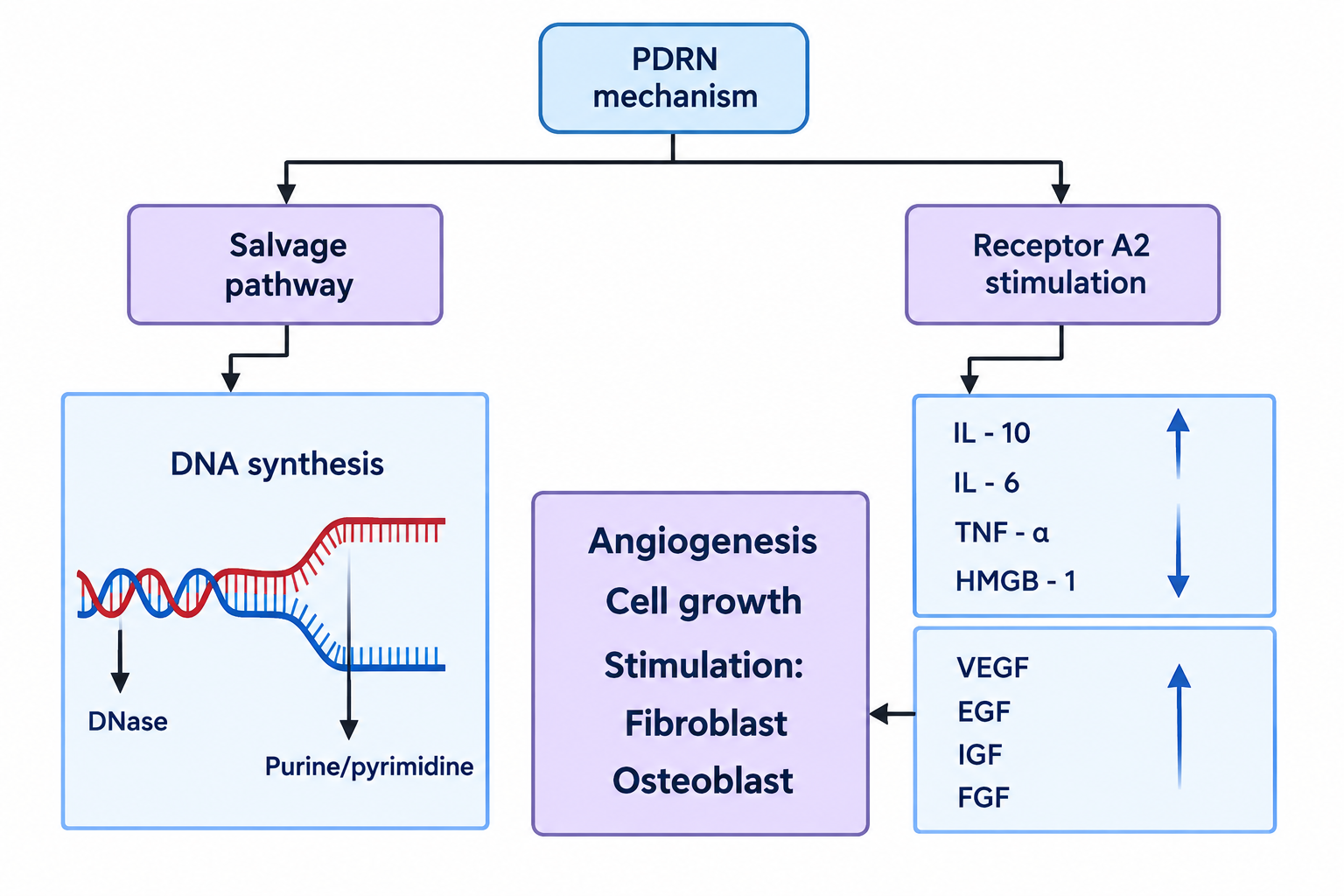 PDRN works two ways: recycling broken-down DNA into raw material for new DNA synthesis (left), and activating adenosine A2 receptors, which calms inflammation and boosts growth factors that drive fibroblast activity, blood vessel growth, and repair (right).
Adapted from Akaberi et al., J Skin Stem Cell, 2025 [8].
Injection or Topical?
Not all PDRN is created equal, and the delivery method changes almost everything about it — how much evidence exists, how well it's regulated, and whether it actually reaches the cells it's supposed to talk to. An injection bypasses the skin barrier entirely; a topical has to fight its way through it. That single difference is why the two have completely different track records, so we're covering them separately.
Clinical evidence for injectable use
In a randomized, placebo-controlled clinical study, PDRN given by intramuscular and subcutaneous injection produced a statistically significant increase in skin reepithelialization compared to placebo [1]. In a larger trial of 216 patients with diabetic foot ulcers, PDRN produced complete wound closure in 37.3% of patients after 8 weeks, versus 18.9% with placebo [3]. For aesthetic use, PDRN is the active ingredient in commercial skin-booster injectables including Rejuran® and Nucleofill® [3]. The clinical picture here is more mixed than for wound healing, and the trials don't all agree with each other:
- a 27-patient split-face trial found Rejuran produced better results than a hyaluronic acid filler — higher aesthetic improvement scores at 16 weeks and greater reduction in skin roughness by week 28 [3].
- a separate study of 218 patients found a 61.4% reduction in periorbital wrinkles after 12 weeks of Rejuran treatment [3].
- however, a 2026 systematic review of PDRN vs HA filler trials found that most existing studies are small — often 30 patients or fewer — with no adequately powered, large-scale trial completed to date; across the available evidence, HA remains the better choice for structural correction, while PDRN shows more consistent benefit for skin quality parameters like elasticity and hydration [9].
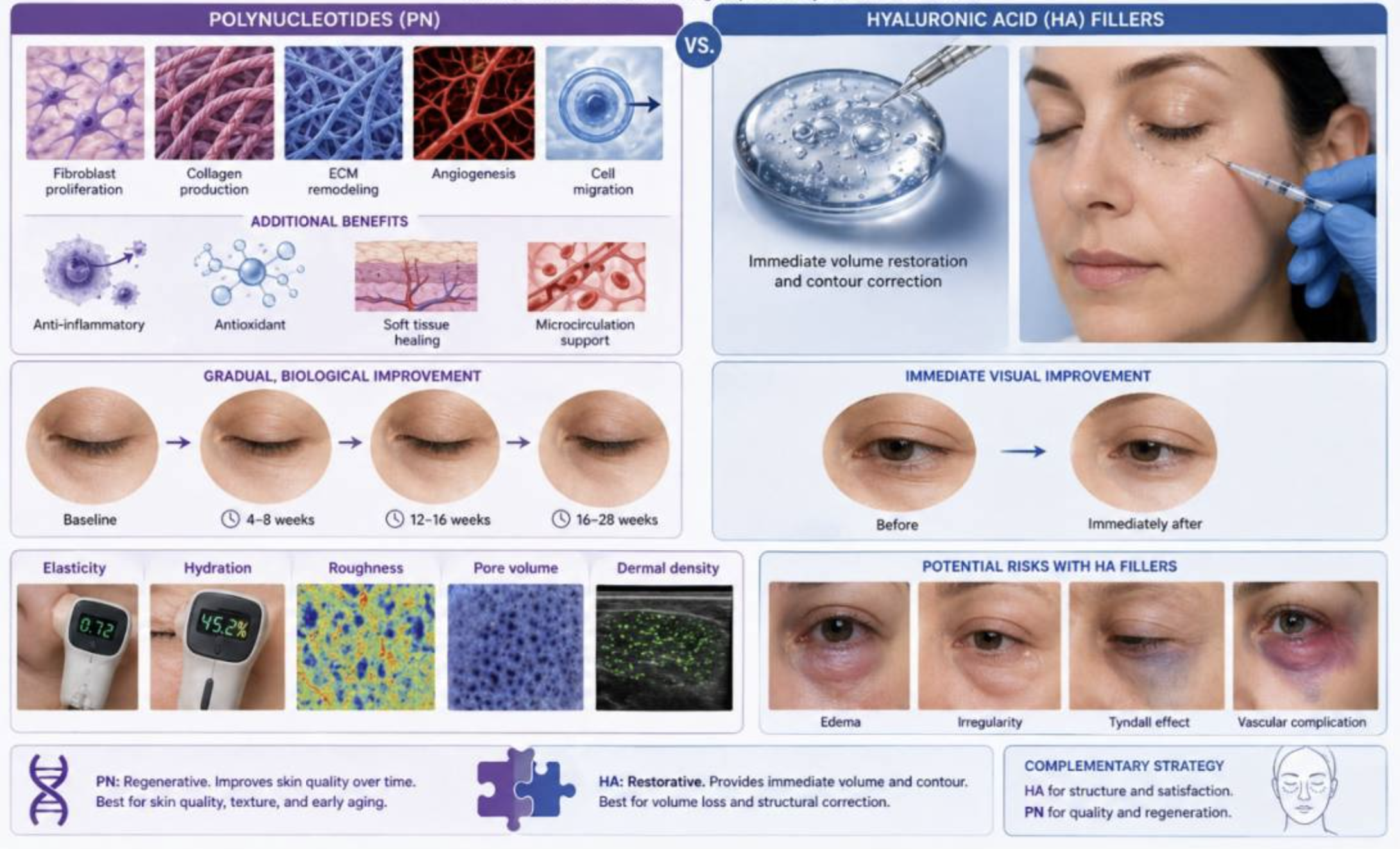 Adapted from Khan et al., Journal of Clinical Medicine, 2026 [9].
Across the available trials, side effects were consistently reported as mild — bruising, swelling, and injection-site pain [3]. These products are sold in the EU, but under a stricter framework than cosmetics: facial injectables are classified as Class III medical devices, the EU's highest risk tier, because the category has documented real harms — product migration, vascular complications, etc. [MDCG 2023-5]
What about topical use?
This is the question that I (and probably most users of the skinclassifier) mostly care about: does the stuff in the serum bottle do anything?
For years, the honest answer was "probably not much" and here's why:
- Size matters. And salmon sperm is too big. PDRN is a large polymer — 50 to 1,500 kDa, depending on the preparation. A molecule that size does not passively cross intact, healthy stratum corneum the way a small molecule like niacinamide (122 Da) can. The dermatology literature holds that compounds need to be under roughly 500 Da to passively penetrate skin at all [10].
- The published evidence base has historically been thin. A 2026 systematic review of randomized controlled trials (RCT) found only seven qualifying RCTs across skin rejuvenation, scar prevention, and wound healing combined, involving 183 total participants — a small evidence base for an ingredient this widely marketed. Of those, the most consistent benefits were in wound healing (faster re-epithelialization, shorter healing time); skin-rejuvenation-specific results were more mixed [11]. For most of PDRN's commercial history, in other words, "topical PDRN" was largely riding on the coattails of injectable PDRN's evidence — a serum borrowing credibility from a completely different delivery method with a completely different molecule-to-skin relationship.
...but that started to change in 2025–2026
With two specific, well-designed studies that actually addressed the size problem head-on rather than ignoring it:
- A December 2025 study examined a plant-derived, low-molecular-weight PDRN sourced from Paeonia lactiflora (peony) root rather than salmon. In lab models, this Low-Peony PDRN increased skin cell proliferation and migration, upregulated genes involved in collagen and elastin production. Clinically, in a small trial of 10 participants, two weeks of topical use meaningfully sped up skin-barrier recovery after a standardized damage test, and four weeks of use produced a statistically significant improvement in periorbital skin elasticity, though the study's own authors note the small sample size limits how far these results can be generalized [12].
- A 2026 randomized, double-blind, split-face trial compared a 0.1% eye cream containing PDRN-850K with an otherwise identical 0.1% retinol eye cream in 31 participants over 28 days. The PDRN cream produced a greater reduction in crow's-feet wrinkle area, approximately 20–23% versus 6–7% with retinol, along with greater improvements in several other instrumental measures of periocular skin. The results are promising, but the short 28-day treatment period means the study cannot establish whether the wrinkle reduction represents lasting structural remodeling or a more temporary effect such as hydration or skin plumping [13].
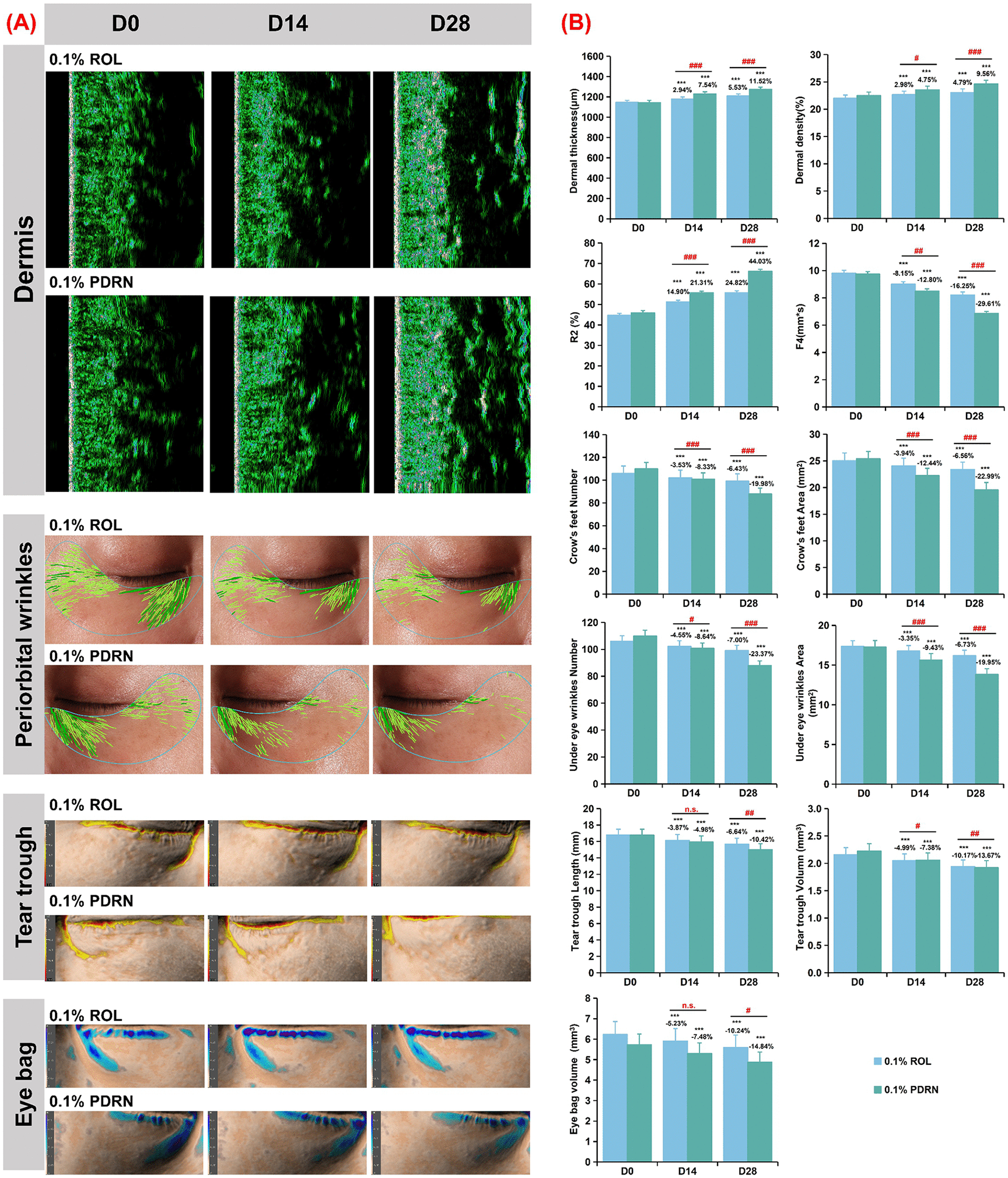 Adapted from Ye et al., PLOS ONE, 2026 [13].
Why this matters — and why it doesn't automatically apply to the product on your shelf.
Both of these studies used specifically engineered, precisely characterized PDRN preparations — a particular molecular weight, a particular source, a particular concentration — tested by researchers affiliated with the companies making the ingredient or product, using material the manufacturer supplied. Neither result transfers automatically to an unspecified "salmon DNA" or "PDRN" listed on an ingredient panel with no molecular weight, source, or concentration given, and neither has yet been independently replicated by a lab with no commercial stake in the outcome. The honest reading of the evidence:
- Topical PDRN can no longer be dismissed outright. The claim "a large DNA molecule cannot possibly do anything topically" seems to be no longer entirely true;
- That does not establish that every topical PDRN product works. The preparations studied were specific materials at specific concentrations and, in the case of the wrinkle study, the treatment was tested for only 28 days.
- An ingredient list rarely gives you enough information to make the connection. "Sodium DNA" or "PDRN" does not tell you the molecular-weight distribution, concentration, source, or whether the finished product has ever been clinically tested.
On safety, the picture is more settled than efficacy across both delivery routes: studies in animals and humans have not found significant toxicity to major organs following systemic administration, and trials in both wound care and skin rejuvenation have generally reported good tolerability with no severe adverse effects [8].
Bottom line: does it work?
Potentially. It does look promising. It's worth a try, with tempered expectations. The two positive results that exist are real, but we are still a long way from a settled "yes". Worth a quick reality check on some claims circulating online: several pages attach very specific numbers — "30% more collagen," "45% better hydration" — but these aren't being directly sourced from scientific papers. And the popular claim that PDRN can replace retinol with none of the downsides oversimplifies a (single!) small study. Don't replace your entire anti-wrinkle stash just yet. Retinol has been tested, refined, and proven over decades. PDRN has been having a good year.
What separates a good PDRN product from a gimmick
A stated concentration. The studies that actually worked used specific percentages (0.1–1%) [12,13]. A stated concentration gives credibility to the label, and helps avoid products that add a very small amount just to be able to take advantage of all the marketing hype around PDRN. PDRN struggles to cross the skin barrier and degrades easily once applied. Researchers have built systems specifically to solve this: PDRN-loaded hydrogels [14] and nanoparticle carriers that protect it from degradation, improving skin penetration by over 150% in one study with real hydration/elasticity gains in human testing [15]. Still, stability is a real, documented concern. Specific storage guidance (temperature, light, pH) for a finished consumer product wasn't found in peer-reviewed literature, but light and air protective packaging would be the safe bet.
A note on the name
"PDRN" won't appear on an ingredient list - the INCI name will. Salmon-derived PDRN is listed as Sodium DNA; the plant-derived version used by the Inkey List on their serum is called Hydrolyzed DNA. The common thread in both is the word "DNA" — a reasonable thing to scan for, though not a guaranteed complete list of every term a brand might use.
Pin it!
References
[MDCG 2023-5] Medical Device Coordination Group. (2023). Guidance on qualification and classification of Annex XVI products — A guide for manufacturers and notified bodies. European Commission. https://health.ec.europa.eu/system/files/2023-12/mdcg_2023-5_en.pdf
- Galeano, M., Pallio, G., Irrera, N., et al. (2021). Polydeoxyribonucleotide: A promising biological platform to accelerate impaired skin wound healing. Pharmaceuticals, 14(11), 1103. https://pmc.ncbi.nlm.nih.gov/articles/PMC8618295/
- Manfredini, M., Poli, P.P., Beretta, M., et al. (2023). Polydeoxyribonucleotides pre-clinical findings in bone healing: A scoping review. Dentistry Journal, 11(12), 280. https://pmc.ncbi.nlm.nih.gov/articles/PMC10743101/
- Park, S., Baek, S., Shin, H.-J., et al. (2025). Polydeoxyribonucleotides as emerging therapeutics for skin diseases: Clinical applications, pharmacological effects, molecular mechanisms, and potential modes of action. Applied Sciences, 15(19), 10437. https://www.mdpi.com/2076-3417/15/19/10437
- Nguyen, T.H., Wang, S.-L., & Nguyen, V.B. (2024). Recent advances on polydeoxyribonucleotide extraction and its novel application in cosmeceuticals. International Journal of Biological Macromolecules, 282(Pt 3), 137051. https://www.researchgate.net/publication/385427978
- Kim, E., Seo, H.H., Shin, D.S., et al. (2025). Safety validation of plant-derived materials for skin application. Cosmetics, 12(4), 153. https://www.mdpi.com/2079-9284/12/4/153
- Hwang, S., Park, S., Lee, J.W., et al. (2026). Paeonia lactiflora callus-derived polynucleotides enhance collagen accumulation in human dermal fibroblasts. Journal of Functional Biomaterials, 17(1), 56. https://pmc.ncbi.nlm.nih.gov/articles/PMC12842499/
- Chae, D., Oh, S.-W., Choi, Y.-S., et al. (2025). First report on microbial-derived polydeoxyribonucleotide: A sustainable and enhanced alternative to salmon-based polydeoxyribonucleotide. Current Issues in Molecular Biology, 47(1), 41. https://pmc.ncbi.nlm.nih.gov/articles/PMC11763902/
- Akaberi, S.M., Sharma, K., Ahmadi-Ashtiani, H.R., et al. (2025). Polydeoxyribonucleotide in skincare and cosmetics: Mechanisms, therapeutic applications, and advancements beyond wound healing and anti-aging. Journal of Skin and Stem Cell, 12(1), e159728. https://www.researchgate.net/publication/390532061
- Khan, R.S., & Hafeez, K. (2026). Hyaluronic acid fillers versus polynucleotides for under-eye rejuvenation. Journal of Clinical Medicine, 15(13), 4971. https://pmc.ncbi.nlm.nih.gov/articles/PMC13361502/
- Bos, J.D., & Meinardi, M.M. (2000). The 500 Dalton rule for the skin penetration of chemical compounds and drugs. Experimental Dermatology, 9(3), 165–169. https://pubmed.ncbi.nlm.nih.gov/10839713/
- Alhussain, A.M., Albusayys, S.T., Alfhadi, M.A., et al. (2026). Polynucleotides and polydeoxyribonucleotides for skin rejuvenation, postoperative scar prevention, and wound healing: A systematic review of randomized clinical trials. Cureus, 18(7), e112403. https://pmc.ncbi.nlm.nih.gov/articles/PMC13453133/
- Bak, S.U., Jung, M.S., Kim, D.J., et al. (2025). Anti-aging efficacy of low-molecular-weight polydeoxyribonucleotide derived from Paeonia lactiflora. International Journal of Molecular Sciences, 27(1), 220. https://pmc.ncbi.nlm.nih.gov/articles/PMC12785872/
- Ye, R., Wang, Q., Du, L., et al. (2026). Topical medium-length PDRN enhances dermal extracellular matrix repair in photodamaged skin via PI3K–Akt/TGF-β–regulated pathways. PLOS ONE, 21(7), e0350905. https://doi.org/10.1371/journal.pone.0350905
- Li, Z., Ma, X., Gao, Q., Zhang, M., & Hu, H. (2023). A photocurable polysaccharide-based hydrogel delivery of polydeoxyribonucleotide-loaded vectors for wound treatment. Molecules, 28(19), 6788. https://doi.org/10.3390/molecules28196788
- Liu, Y., Hu, W., Zhao, C., et al. (2026). pH-responsive nanocarrier: Chitosan-polydeoxyribonucleotide (PDRN) nanoparticles for transdermal nucleic acid therapy. European Polymer Journal, 243, 114499. https://www.sciencedirect.com/science/article/abs/pii/S0014305726000042