Volufiline: Can Your Skincare Actually Grow Facial Fat?
Published on November 27, 2026
The pitch behind Volufiline is unusual even by skincare standards. The claim is not about collagen, or hydration, or even prevention. It's about fat.
Its patent claims a cosmetic "lipofilling" effect: when applied to the face, lips, cheeks, eyelids, neck or buttocks, it is said to make the body build its own fat tissue in that spot [1]. So in 2026, we got rid of fat with GLP-1, and now it seems we are trying to get it back (strategically) with Volufiline.
Seems like a breakthrough cosmetic find, right? This means a cream could be doing the job of an injectable. What a revolutionary discovery for skincare this year. So imagine my surprise when I discovered Volufiline is actually over 20 years old.
- What actually is Volufiline?
- So... why now?
- How is it supposed to work?
- What does the evidence show?
- What are you actually getting in a bottle of Volufiline?
- The bottom line
- References
What actually is Volufiline?
Volufiline is a trade name, not an ingredient name. It was developed and patented by the French ingredient supplier Sederma, and its active molecule is sarsasapogenin [1]. Sarsasapogenin is a steroidal sapogenin, a plant compound with a steroid-shaped backbone. It comes mainly from the root of Anemarrhena asphodeloides, a plant known in Chinese medicine as zhi mu [2]. The root has been used in traditional medicine to treat fever, cough and constipation [2].
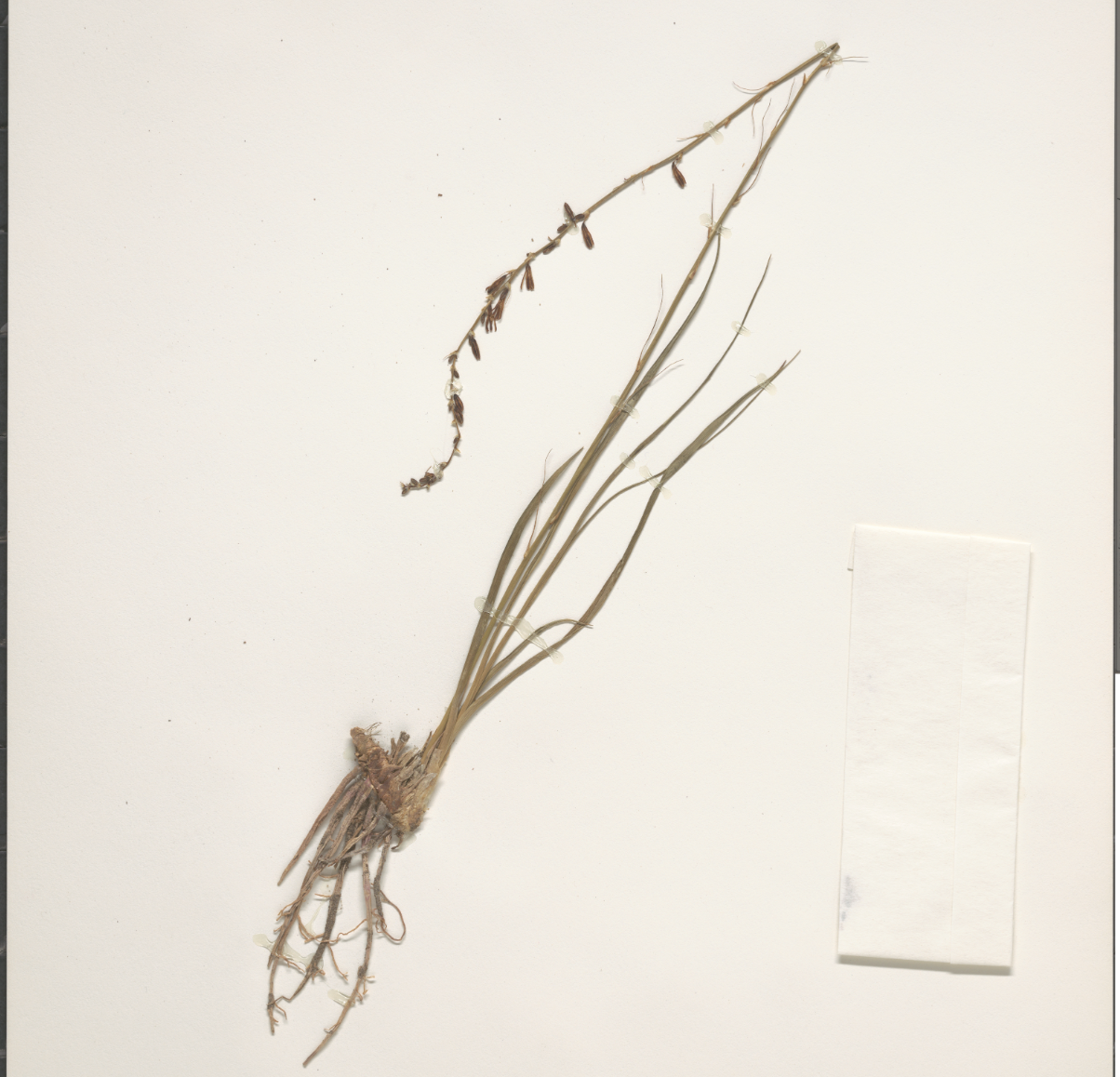 Anemarrhena asphodeloides, the main source of sarsasapogenin [2].
Anemarrhena is not the only source. Sarsasapogenin is also found in asparagus, yucca and sarsaparilla (smilax ornata) [2].
Neither the plant nor the molecule is new, and Sederma wasn't the first company to extract that molecule, which makes you think what is it that they actually patented with Volufiline. Well, the patent is actually not a compound, but a use: applying sarsasapogenin to the skin to make fat tissue grow, for a cosmetic "lipofilling" effect [1]. The patent covers sarsasapogenin from any source, including chemical synthesis and around 40 plants such as asparagus, yucca and fenugreek, and names Anemarrhena as the preferred one [1]. Volufiline is just Sederma's branded raw material for that use [1,3].
So... why now?
Sederma filed its patent in France in 2006, and the US patent was granted in 2013 [1]. Its early marketing targeted the body, with creams for the breasts and buttocks [3].
Apparently, the move to the face started on TikTok: a small group of creators began mixing the raw ingredient into their own skincare and applying it to areas of the face with volume loss [4]. It was then promoted as the topical answer to "Ozempic face" and to facial volume loss in general [5]. Volufiline has been regarded and sold as an at-home, toned down alternative to fillers, but dermatologists caution against this overexagerated comparison [6,7].
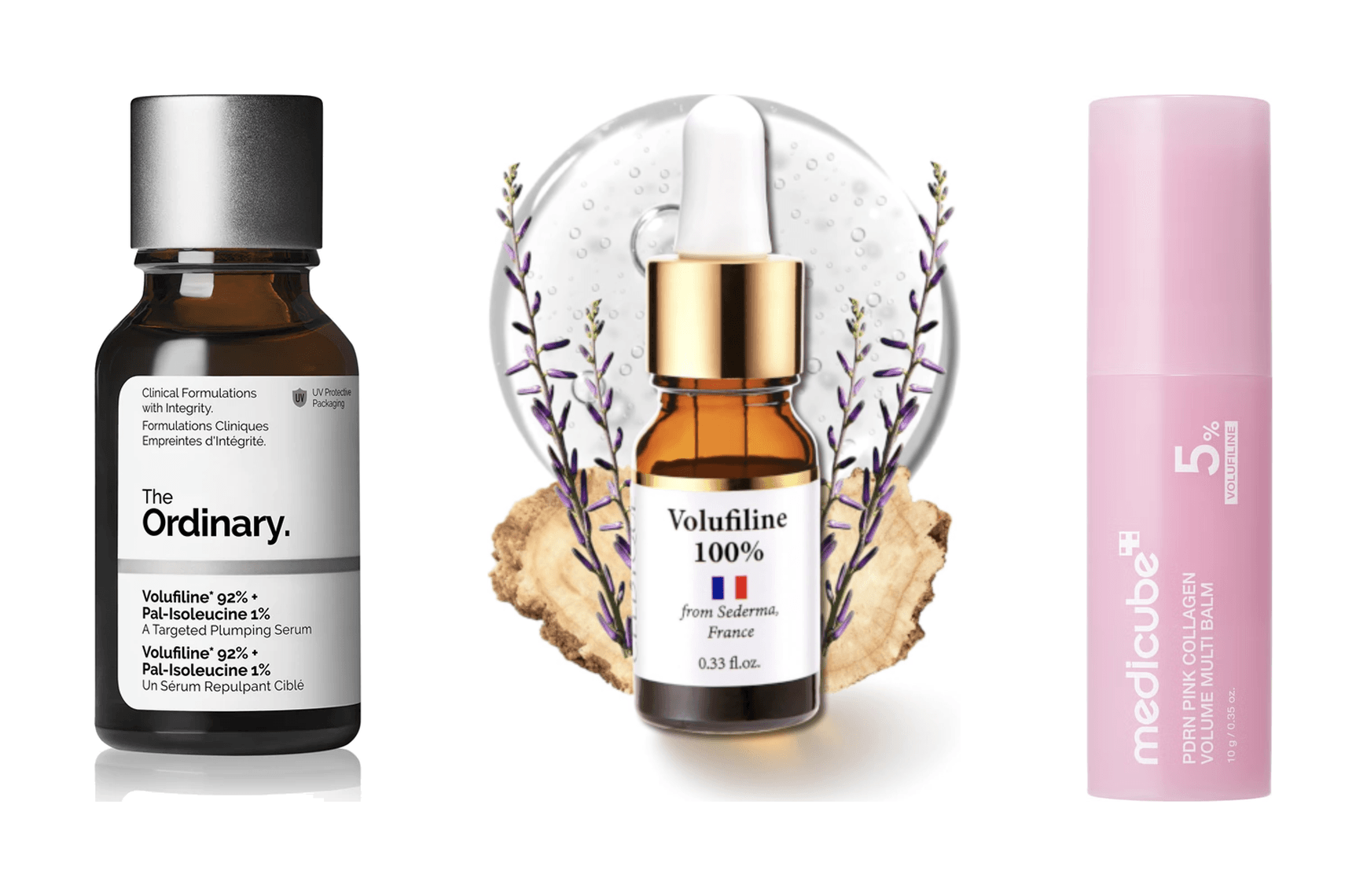
Until recently, the ingredient was hard to buy at mass scale, but launches from The Ordinary and Medicube turned it into a mass-market product [7].
How is it supposed to work?
The fat under the skin is made of fat cells (adipocytes). Their numbers can grow, and each one can store more or less fat [1]. The patent claims sarsasapogenin does two things [1]:
- Adipogenesis[8]: it pushes precursor cells to turn into new fat cells.
- Lipogenesis[9]: it makes existing fat cells store more fat.
More fat cells, each holding more fat, would mean more volume in that area. That is the theory.
The fat-building effect appears in the manufacturer's patent [1]. It does not, however, appear in the independent literature. A 2022 review of everything published on sarsasapogenin lists its studied effects as anti-inflammatory, anticancer, antidiabetic, bone-protective and neuroprotective [2]. Building fat is not among them. The independent studies that did look at sarsasapogenin and fat tissue studied something else entirely. In obese mice, sarsasapogenin taken by mouth reduced inflammation inside fat tissue and improved how fat cells responded to insulin [10]. That is about calming existing fat tissue, not adding to it.
What does the evidence show?
Nothing has been peer-reviewed on humans. PubMed lists no clinical trial of Volufiline or of sarsasapogenin applied to skin (searched 14 November 2026).
The only human data comes from Sederma itself, in its patent [1] and its product brochure [3]. The study was single-blind: each woman applied the cream to one breast, chosen at random, and left the other untreated [1]. Thirty-two women aged 18 to 35 with small breast volume enrolled, and 28 could be evaluated at 56 days [1]. The cream was applied twice a day, and only the upper part of the breast was measured [1].
After 56 days, average volume rose 2.2% on the treated side and 0.9% on the untreated side, with p=0.1 [1]. At 28 days the result was p=0.3 [1]. Neither result is statistically significant at the standard 95% confidence level, which requires p below 0.05. The patent itself calls the 56-day result "significant at the p=0.1 level" [1]. The "up to 8.4%" figure in Sederma's marketing is the average of the 8 best responders (first quartile), not of the whole group [1,3]. Skin elasticity, measured at the same time, did not change [1]. The study measured the breast, not the face.
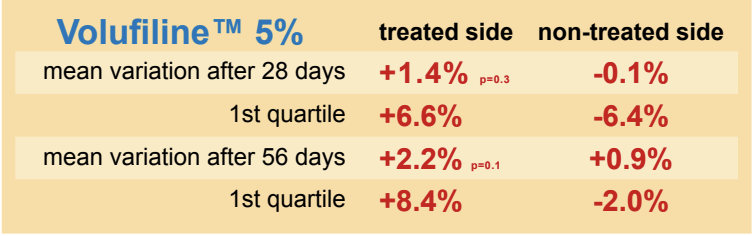 Results of the breast study as presented by Sederma [3].
Can it even reach the fat?
The fat that Volufiline targets sits in the hypodermis, beneath the skin's two main layers, the epidermis and the dermis [11]. Molecules under roughly 500 Daltons can pass into the skin, and larger ones mostly cannot [12]. Sarsasapogenin weighs 416.6 Daltons [2], so it is under the limit.
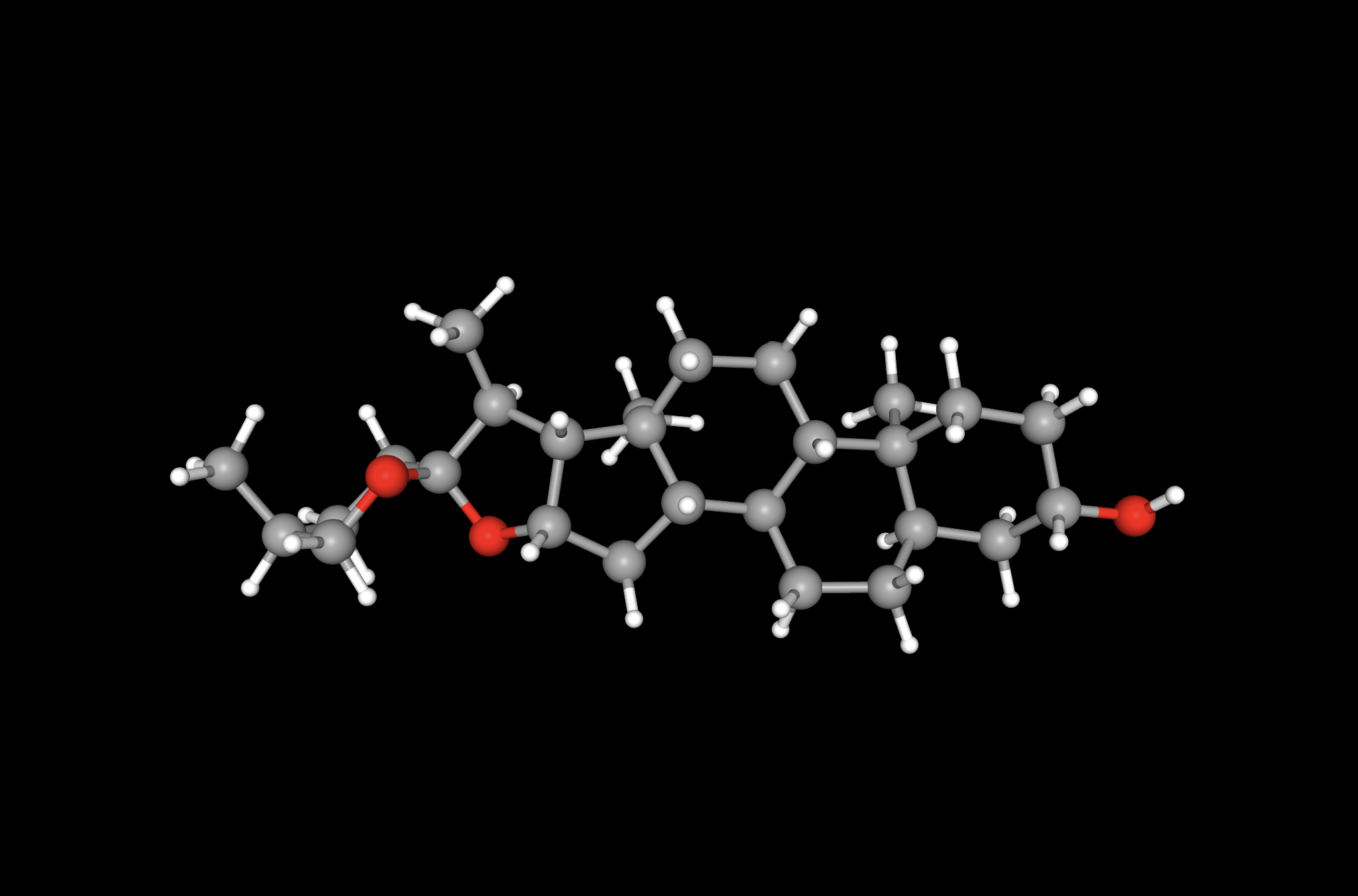 Sarsasapogenin, the active molecule in Volufiline, weighs 416.6 Daltons [2].
Getting into the skin and getting all the way down to the fat layer are different things, though. Sarsasapogenin barely dissolves in water [2], and no published study has measured how much of it, applied as a cream, reaches the fat layer.
What are you actually getting in a bottle of Volufiline?
Volufiline does not appear on an ingredient list under its trade name. Its INCI name, as listed by its supplier, is Hydrogenated Polyisobutene (and) Anemarrhena Asphodeloides Root Extract [3]. The supplier defines Volufiline as sarsasapogenin in an oil-soluble carrier [3]. In CosIng, the EU's official ingredient database, Anemarrhena Asphodeloides Root Extract is listed with one function: skin conditioning [13].
"Anemarrhena Asphodeloides Root Extract" on its own does not prove a product contains Volufiline. Anemarrhena Asphodeloides Root Extract and sarsasapogenin are not synonyms. Sarsasapogenin is extracted from the root, but other extracts of the same root are made and tested for other purposes, such as skin whitening and wrinkle reduction [14].
The label also gives no indication of dose. The patent covers sarsasapogenin from 0.000001% up to 20% of a formula, with a preferred range of 0.0001% to 0.1% [1].
The best-known Volufiline product is The Ordinary's Volufiline 92% + Pal-Isoleucine 1% [15]. Its full ingredient list is Hydrogenated Polyisobutene, Caprylyl Glycol, Polyglyceryl-3 Stearate, Palmitoyl Isoleucine, Anemarrhena Asphodeloides Root Extract, Rhus Succedanea Fruit Wax and Tocopherol [15].
"92% Volufiline" does not mean 92% active ingredient. Volufiline is the root extract in an oil-soluble carrier, hydrogenated polyisobutene [3], so most of that 92% is the carrier. CosIng lists hydrogenated polyisobutene as a skin-conditioning ingredient and an emollient [16].
The order of the list says more. EU labels list ingredients in descending order of weight, except those at 1% or less, which can appear in any order [17]. The root extract comes after Palmitoyl Isoleucine, which the product name puts at 1% [15]. The extract is therefore at 1% or less of the formula - and still, how much sarsasapogenin that extract contains is not disclosed.
The product page claims the serum is "formulated to visibly target loss of volume" but reports no study on the product itself [15]. The Ordinary has run a short-term hydration study on the formula to check that it suits all skin types [18]. The only data on volume remains Sederma's breast study [1].
The bottom line
- The claim that Volufiline builds fat comes from its manufacturer [1], and no independent study has confirmed it.
- The only human trial is the supplier's own. It tested the breast, not the face, and its results were not statistically significant [1,3].
- Sarsasapogenin is small enough to enter the skin [2,12], but no study shows it reaching the fat layer from a cream.
The molecule isn't new, the idea isn't new, and the only human study behind it is small, run by the company that sells it, done on breasts rather than faces, and not statistically significant. That doesn't prove it does nothing - but it means the volume claim is still a hypothesis being sold as a result. If you like how the serum feels on your skin, and you think it's helping nourish it, sure, enjoy it for that. Just don't expect it to do a filler's job.
Note on sourcing: All claims above are drawn from peer-reviewed literature or official databases, except [1], the manufacturer's patent, and [3], the supplier's brochure. Both are cited only as the source of the claims themselves. Press coverage [4–7, 18] is cited only for how the trend spread and for what brands have said.
References
- Lintner, K., Mas Chamberlin, C. (2013). Composition comprising sarsasapogenin. US Patent 8,361,516 B2, assigned to Sederma. https://patents.google.com/patent/US8361516B2
- Mustafa, N.H., Sekar, M., Fuloria, S., et al. (2022). Chemistry, biosynthesis and pharmacology of sarsasapogenin: a potential natural steroid molecule for new drug design, development and therapy. Molecules, 27(6), 2032. https://pmc.ncbi.nlm.nih.gov/articles/PMC8955086/
- Sederma. (2010). Volufiline™: promotes body volume by a cosmetic lipofilling-like effect [product brochure]. https://soap-formula.ru/assets/sertifikati_new/active/Volufiline_pres_en.pdf
- Engler, A. (2026). This viral skin care ingredient claims to be the answer to age-related facial volume loss. mindbodygreen. https://www.mindbodygreen.com/articles/can-you-actually-do-anything-about-volume-loss-this-ingredient-may-be-answer
- Adore Beauty. (2026). What is Volufiline? BeautyIQ. https://www.adorebeauty.com.au/beautyiq/skincare/what-is-volufiline-the-ordinary/
- Harper's Bazaar India. (2026). What is Volufiline, the topical ingredient everyone is calling a filler alternative. https://www.harpersbazaar.in/beauty/story/what-is-volufiline-the-topical-ingredient-everyone-is-calling-a-filler-alternative-1431110-2026-07-29
- Hypebae. (2026). TikTok claims volufiline is filler in a bottle, so we asked experts to weigh in. https://hypebae.com/2026/5/volufiline-filler-skincare-ingredient-the-ordinary-medicube-dermatologist-interview-beauty-trend-explainer
- https://www.sciencedirect.com/topics/agricultural-and-biological-sciences/adipogenesis
- https://www.sciencedirect.com/topics/biochemistry-genetics-and-molecular-biology/lipogenesis
- Yu, Y.Y., Cui, S.C., Zheng, T.N., et al. (2021). Sarsasapogenin improves adipose tissue inflammation and ameliorates insulin resistance in high-fat diet-fed C57BL/6J mice. Acta Pharmacologica Sinica, 42(2), 272–281. https://pmc.ncbi.nlm.nih.gov/articles/PMC8027656/
- Wong, R., Geyer, S., Weninger, W., et al. (2016). The dynamic anatomy and patterning of skin. Experimental Dermatology, 25(2), 92–98. https://doi.org/10.1111/exd.12832
- Bos, J.D., Meinardi, M.M. (2000). The 500 Dalton rule for the skin penetration of chemical compounds and drugs. Experimental Dermatology, 9(3), 165–169. https://pubmed.ncbi.nlm.nih.gov/10839713/
- European Commission. (n.d.). CosIng: Anemarrhena Asphodeloides Root Extract. https://ec.europa.eu/growth/tools-databases/cosing/details/54462
- Lee, M.H., Jang, D.I., Choi, J. (2023). The assessment of the skin-whitening and anti-wrinkling effects of Anemarrhena asphodeloides Bunge root extracts and the identification of nyasol in a developed cream product. Cosmetics, 10(3), 73. https://www.mdpi.com/2079-9284/10/3/73
- The Ordinary. (n.d.). Volufiline 92% + Pal-Isoleucine 1% [product page]. https://theordinary.com/en-lk/volufiline-92-pal-isoleucine-1pct-plumping-serum-100724.html
- European Commission. (n.d.). CosIng: Hydrogenated Polyisobutene. https://ec.europa.eu/growth/tools-databases/cosing/details/76643
- European Parliament and Council. (2009). Regulation (EC) No 1223/2009 on cosmetic products, Article 19(1)(g). Official Journal of the European Union, L 342, 59–209. https://eur-lex.europa.eu/eli/reg/2009/1223/oj
- Marie Claire. (2026). Does Volufiline deliver filler-like plumping or is it all a marketing ploy? Beauty experts weigh in. https://www.marieclaire.com/beauty/skincare/volufiline-ingredient-benefits-risks